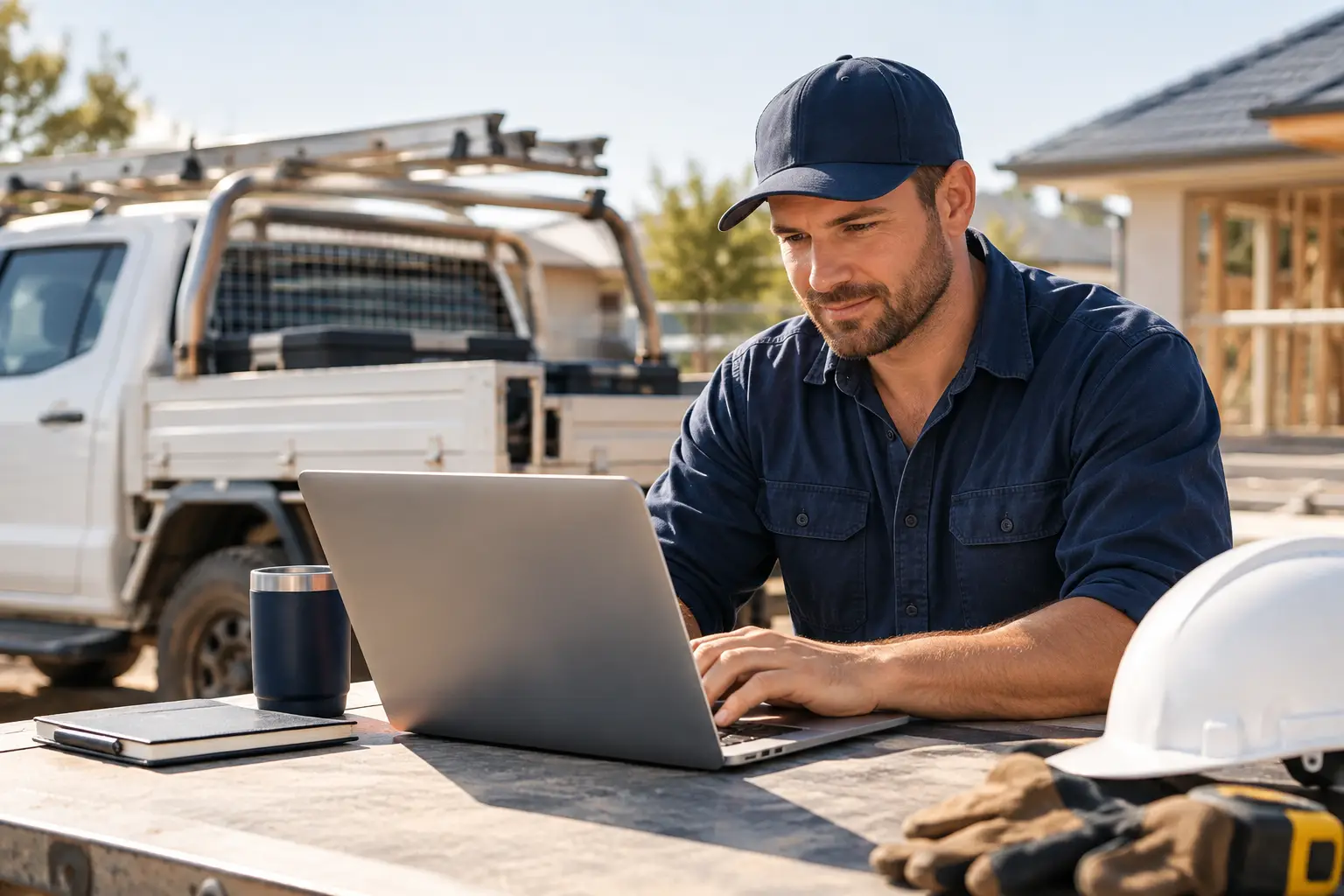
A homeowner finds your business after dinner, standing in a leaking laundry or staring at a switchboard that has started making strange noises. They check your mobile site before they call. If it is slow, out of date, missing real project photos or hard to contact, they move on to the next tradie in seconds. Custom websites for tradies are not about having a flashy online brochure. They are about making it easier for the right customer to trust you, contact you and choose you.
For an established trade business, the website should also do more than collect leads. It should be the first useful part of a system that reduces the chasing, double-handling and notebook administration that steals time from paid work.
A template site can make a good business look ordinary
Most tradies do not lose work because they cannot do the job. They lose it at the point where a prospect is deciding who looks reliable enough to call. A generic template with stock photos, vague services and an old phone number tells the customer very little about how your business operates.
The problem gets worse on mobile. Most local customers are searching from the ute, the office or their kitchen bench. They want to know whether you service their suburb, whether you handle their type of job, when they can expect a response and how to get in touch without filling out a painful form.
A custom-built site gives that information a proper home. It reflects your actual work, service area and process rather than forcing your business into a pre-made layout designed for everyone from cafés to accountants.
That does not mean every trade business needs an expensive feature-heavy website. A sole electrician working across Ipswich has different needs from a Brisbane plumbing business with multiple crews. The right build depends on the work you want more of, the jobs you want to avoid and what happens after an enquiry lands.
What custom websites for tradies should actually do
A good website has a commercial job. It needs to help a new customer feel confident enough to make contact, then give your team the information needed to respond properly.
For a roofing contractor, that may mean showing clear before-and-after work, explaining inspection options and capturing the roof type, suburb and urgency. For an air conditioning business, it may mean separating installation, servicing and breakdown enquiries so the right person can deal with each one. For a builder, it may mean qualifying renovation leads before a site visit is booked.
The details matter because poor enquiries create their own workload. If every website form arrives as "Need a quote", someone has to call back, find out the basics, write the details down and hope the lead does not disappear in the meantime.
A custom website can collect the right information from the start and send it where it needs to go. That might be to a shared inbox, a job register, a quoting workflow or a simple internal dashboard. The goal is not to add technology for its own sake. The goal is to stop good enquiries falling through gaps.
Trust is built in the practical details
Trade customers look for signals that you will turn up, communicate clearly and stand behind the work. Your site should make those signals easy to find: the suburbs you cover, your licences and qualifications where relevant, real job photos, clear service descriptions and a straightforward way to contact you.
It also needs to look cared for. An old special offer, a broken contact form or a page that barely works on mobile raises an obvious question: if this is how the business manages its own details, what will the job be like?
The answer is not to make big claims you cannot support. It is to present the evidence you already have in a clear, professional way.
The website should not become another supplier lock-in
Plenty of web agencies will build a site, host it in their account and keep the controls behind a support ticket. You may have paid for the work, but changing providers later can mean arguing over logins, paying a handover fee or rebuilding from scratch.
That is not a small administrative annoyance. Your domain, website files, hosting account and business email are core business assets. Losing access to any of them can interrupt enquiries and leave you exposed at exactly the wrong time.
A fair arrangement puts those assets in your name from the beginning. You should own your domain, source code, hosting account, administrative email and tool register. You should know what has been built, what it costs to run and how to move it if you ever choose to.
Ownership does not mean being left to manage technical work yourself. It means you have the keys while a capable team handles the engineering. The distinction matters when a provider changes direction, becomes hard to reach or tries to turn a basic update into an ongoing dependency.
Build the front door first, then fix the bottlenecks behind it
For many trade businesses, a better website exposes the next operational problem quickly. More enquiries arrive, but quotes are still being drafted from old notes. Booking details are spread between text messages and diaries. Follow-ups depend on remembering who was meant to be called on Friday.
This is where a custom website can become the first stage of a better operating system. Once your enquiry process is clear, it can connect to simple tools that suit the way your business already works.
You might start with a form that creates a properly structured lead record. Next, a quoting workflow could prompt follow-ups after a set number of days. Later, booking confirmations, job reminders, invoice triggers and review requests can be organised around the same process.
Not every business should automate everything. High-value custom jobs often need a personal conversation and site inspection before a quote can be prepared. Emergency work needs speed, not a lengthy questionnaire. The point is to remove repeatable admin while keeping human judgement where it earns its keep.
What to expect from a proper build
A custom project should begin with a focused scoping conversation, not a drawn-out sales process full of vague promises. The developer needs to understand your services, best jobs, service area, existing enquiry process and where work is currently getting stuck.
From there, the project should have a fixed price, written delivery dates and a clear scope. You should know who is responsible for content, photography, approvals and technical setup. If the scope changes, that should be discussed plainly rather than quietly appearing on an invoice later.
Custom-coded does not mean you need to wait months for a simple business site. It means the work is engineered for your requirements rather than assembled from a stack of plugins that can become fragile or expensive to maintain. It also means future improvements can be made with a clear understanding of how the site works.
At Archway Automation, the website is built as an accountable first step: client-owned infrastructure, defined delivery dates and post-launch support while the new process settles in. That gives established owner-operators a usable foundation rather than another subscription they do not control.
Before you commission a new site, ask the hard questions
The cheapest quote is not always the expensive mistake, but it can be if nobody can explain what you are buying. Ask whether the site will be built in accounts you own, whether you receive the source code and what happens if you move providers. Ask how leads are handled after a form is submitted, not just how the form looks.
You should also ask what is included after launch. A website is not finished because it has gone live. Someone needs to test the contact paths, check it on real mobiles and make sure notifications arrive where they should. Early support is especially valuable when staff are adjusting to a new enquiry process.
Finally, look for accountability. Written dates matter. Clear communication matters. If a provider misses a deadline or goes quiet for days, that is not just frustrating. It delays the part of your business that is meant to bring in work.
The useful question is not, "Do we need a new website?" It is, "What would change if every worthwhile prospect could quickly see we are legitimate, contact us easily and receive a prompt response?" Build around that answer, keep the keys in your own hands, and the website starts earning its place long before the next busy season.